Don't Get Soaked Twice: How to File, Fight, and Win a Flood Insurance Claim

Your homeowners policy almost certainly won't pay a dime when the water comes in, and most people find that out while they're standing in it. Flooding is America's most common and most costly natural disaster. Nearly a third of flood insurance claims come from areas officially labeled "low risk," and a single summer storm or burst water main can wipe out years of savings overnight. Here's FEMA's guide to getting covered, protecting your records, and fighting back if your claim is denied. Read it before the next forecast.
Understand your risk
Look up your address in the Flood Map Service Center to learn if you live, work or travel in areas that are at higher risk for flooding.
In simple terms, a flood is an excess of water on land that is normally dry, affecting two or more acres of land or two or more properties. For example, damage caused by a sewer backup is covered if the backup is a direct result of flooding. Official Definition of a flood - NFIP Summary of Coverage.
Get flood insurance if you don't already have it
Most homeowners insurance does not cover flood damage. The National Flood Insurance Program (NFIP) can help you find an insurance provider. Use our insurance provider finder to locate an agent. An agent can help answer questions that are specific to your situation and get you a quote for a policy. Call to check your policy or explore a new one: NFIP at (877) 336-2627.
Prepare your home and documents
Take photos and videos of all major household items and valuables. Store these documents in a safe waterproof place because they are important when filing insurance claims.
Save copies of birth certificates, passports, medical records and insurance papers in a safe, dry place. Keep original documents in a watertight safety deposit box.
WHY get flood insurance?
Where it rains, it can flood. No home is completely safe from a flood event. Unfortunately, many property owners do not find out until it's too late that their homeowners insurance policies do not cover flooding.
Homeowners insurance doesn’t cover floods
Most homeowners insurance does not cover flood damage. Only flood insurance covers the cost of rebuilding after a flood.
Why get flood insurance?
Everyone has SOME risk. Flooding can happen anywhere at any time. Poor drainage systems, summer storms, melting snow, neighborhood construction, and broken water mains can cause flooding.
29% of claims
Almost one-third of NFIP flood insurance claims come from OUTSIDE high-risk flood areas.
Faster recovery
Rebuilding after a flood can be difficult. If you have flood insurance, you don’t have to go through it alone.
It might be required
Many property owners, particularly those in high-risk flood areas, may be required to have flood insurance.
Peace of mind
No home is completely safe from potential flooding. Flooding is the most common and the most costly natural disaster. 90% of all presidentially declared U.S. natural disasters involve flooding. Flood insurance can be the difference between recovery and financial devastation.
What is covered?
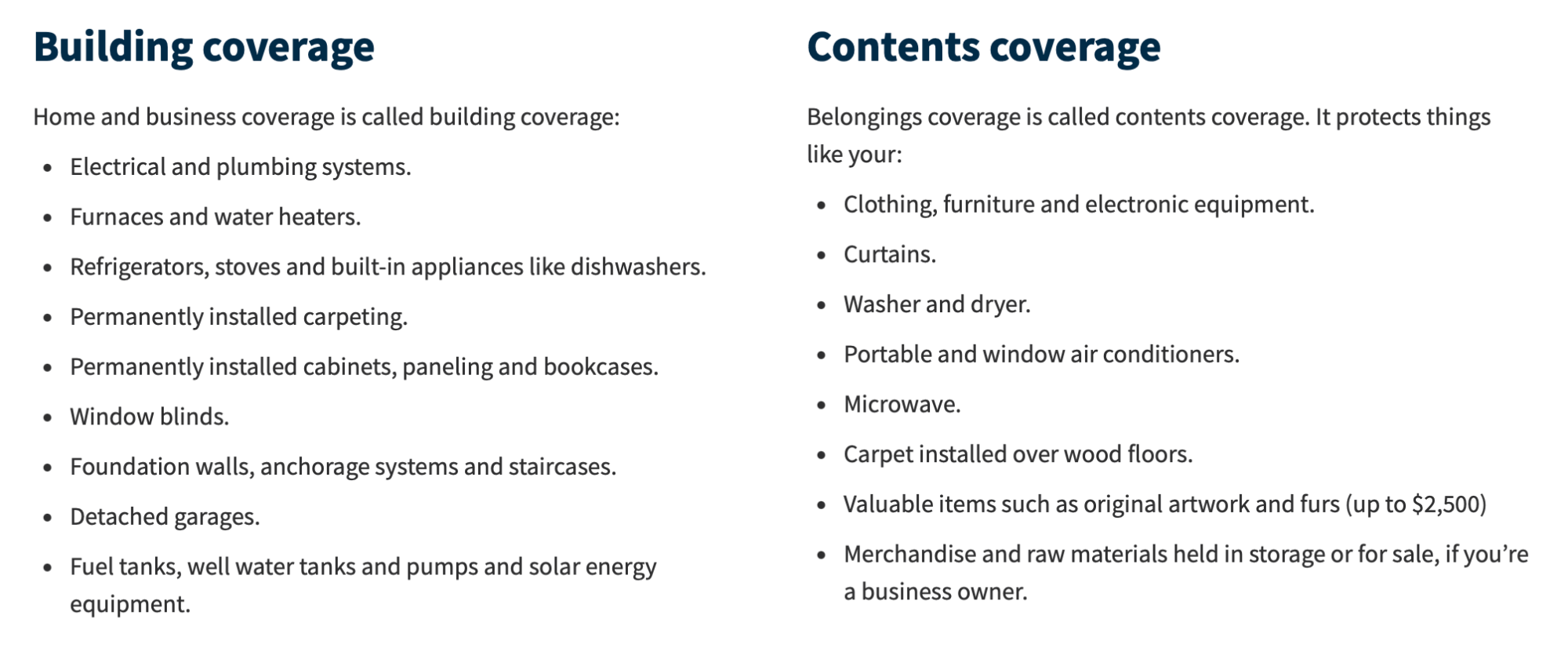
In the event of a flood, your NFIP policy covers direct physical losses to your structure and belongings.
The NFIP offers two types of coverage; building coverage and contents coverage.
There are many circumstances that factor into what is covered, such as where you live, the kind of house you live in, the age of your home, and how it's built and arranged. Below are links to learn more.
Report your loss immediately to your insurance agent or carrier. Need help finding your insurance agent or carrier? Call the NFIP at (877) 336-2627.
Recover From a Flood
Recovering after a flood can feel overwhelming. Following simple steps can help you clean up safely, protect your home and start getting life back to normal.
What to know about starting a flood insurance claim
Start your flood insurance claim as soon as possible after a flood
An insurance adjuster will come to your property to view your flood damage and create a claim estimate
It can take 4-8 weeks before a claim is finalized and paid (In rare instances it could be longer)
If your claim is denied, you can work with your insurance agent or appeal to FEMA
How to appeal a denied flood insurance claim
The NFIP wants to ensure you are on the road to recovery after a flood. If your claim is denied, or if you’re not satisfied with your claim amount, you can appeal to your insurance provider or with FEMA directly.
Ways to appeal your flood insurance claim
Work with your flood insurance adjuster and insurer
Talk to your adjuster or your flood insurance company if some or all of your claim was denied. You can ask them for additional payment, and they can clarify how your flood insurance policy applies to your claim.
Insurers and adjusters can take immediate action if they missed a key fact, overlooked a document or made a mistake.
File a flood insurance appeal with FEMA
If your claim is denied, you have a 60-day window to file an appeal with FEMA from the date of the letter. FEMA will work with you and your insurer to gather the facts, review the policy and provide an appeal decision.
There is no fee to file an appeal, and you do not need a third party to represent you.
Get an appraisal
You and your insurer may agree that a loss occurred but disagree about the cost of the loss. An appraisal can help resolve the disagreement; however, if you complete an appraisal you cannot file an appeal with FEMA.
File a lawsuit
If you are unable to resolve your dispute through discussion, appraisal or appeal, you can file a lawsuit against your insurer.
You must file suit within one year of the denial of your claim. Once you file suit, you forfeit your option to appeal directly with FEMA.
You may file a lawsuit after filing an appeal with FEMA. However, filing an appeal does not extend the one-year period of time to file suit.
Immediately After a Flood
Ensure safety first
Ensure safety first—do not reenter a property until it is safe to do so. You can file a claim before returning to your property.
Report your claim
Don't delay reporting your claim. Call your insurance agent or insurance provider as soon as possible. You should have your policy number, if available.
Determine the type of coverage
Determine the type of coverage you have (building, contents or both) and begin documenting your flood loss. Talk to your insurance provider about your coverage limits and deductibles. If applicable, ensure the correct mortgage company is listed on your flood insurance policy’s declarations page to avoid payment delays.
Log all conversations
Be sure to keep a log of all conversations with your insurance provider (date, time, name of representative, assigned adjuster, what was discussed), as well as adjusters, contractors, cleaners, etc.
Preparing Your Claim
Your insurance provider will assign an adjuster to contact you within 48 hours of reporting your loss. Do not discard anything before your adjuster sees it, unless the damaged items present a health hazard or local law requires you to discard them. Gather supporting documentation, such as receipts or invoices, if you have them.
Safely begin cleanup
Consult with your insurer on what cleaning expenses and repair services are covered by your flood insurance policy.
Separate damaged property from undamaged property, so that the adjuster can thoroughly inspect and evaluate the loss. Make every effort to protect undamaged property.
If disposal of flood-damaged items is necessary, keep samples of carpet or flooring, blinds, etc., to show your adjuster.
Building coverage
If you have building coverage and it is safe to do so, take photos and videos of all damage from multiple angles and distances:
Capture the exterior and interior of your flood-damaged structure, including signs of structural damage and floodwater lines inside and outside of your structure.
Capture the make, model and serial number of appliances, electronics or any other items of exceptional value. Refer to your Standard Flood Insurance Policy (SFIP) for a list of covered items.
Contents coverage
If you have contents coverage and it is safe to do so:
Create a list of damaged items, include descriptions, values, make, model and serial number, quantity, approximate age and replacement cost value.
Take photos and videos of damaged personal property that will need to be replaced inside the building.
Working With Your Adjuster
Your assigned adjuster will conduct an inspection of your property following a flood.
Meet with your adjuster
When you meet the flood insurance adjuster, make sure they show you their Flood Control Number (FCN) card and government-issued photo ID.
Ask questions
Ask the adjuster any questions regarding the claims process, coverage and next steps.
Advanced payment
You may request an advanced partial payment of your claim.
Documentation
Give the adjuster your documentation of the loss, including pictures, videos and other supporting information
Finalizing the Claim & Receiving Payment
Submit documentation
Ask for the address as to where to submit your documentation to your insurer. Submit all required documentation to support your claim to your insurance provider within 60 days of the flood, or within the timeframe your adjuster or insurance provider provides, to receive payment.
Review the estimate provided by the adjuster carefully to ensure it is accurate and complete. Work with them to correct any mistakes.
Request an additional payment
Request an additional payment from your insurance provider if you notice additional damage to your structure or personal property, discover a missed or misidentified item in the estimate or learn the cost to repair the covered flood damage exceeds your adjuster’s estimate. This can be requested at any time, even if you think your claim has been settled.
After the Claim is Finalized
Keep all claim documentation for your records.
Complete any necessary repairs and photograph and keep receipts for them. If you have a future claim for the same damaged item, you may be asked to provide proof of repair and receipts.
Update your home inventory for any replaced items.
If your claim is denied, you have the right to file an appeal via mail or email with FEMA within 60 days after you receive a letter from your insurance provider.
Rebuild better after a flood
If your home or business was badly or repeatedly damaged by a flood, the National Flood Insurance Program (NFIP) offers Increased Cost of Compliance (ICC) coverage that can help you rebuild after a flood.
Flood insurance costs a fraction of what it takes to rebuild, and it takes about 30 days to kick in, so the time to buy it is well before the clouds roll in. Check your risk, call an agent, and photograph your belongings this week. When the water rises, you want to be the neighbor with a claim number.
Originally published by the Federal Emergency Management Agency (FEMA). Republished by CityGov as a public resource.