Doctor's Orders, Boss's Rules: Who Gets Time Off When Life Calls

Doctor’s appointments (for ourselves, our family, and our pets), school functions, errands—occasionally workers need to take an hour or two off during work hours. Whatever the reason, taking time off during work hours may be easier for some workers than others.
On average, 69.1 percent of wage and salary workers found it would not be difficult to take an hour or two off during work hours in 2024–25. In contrast, 20.3 percent of workers found it somewhat difficult, and 10.6 percent found it very difficult. A higher share of men (72.0 percent) than women (66.0 percent) found it not difficult to take an hour or two off. Accordingly, a higher share of women (12.4 percent) than men (9.0 percent) found it would be very difficult.
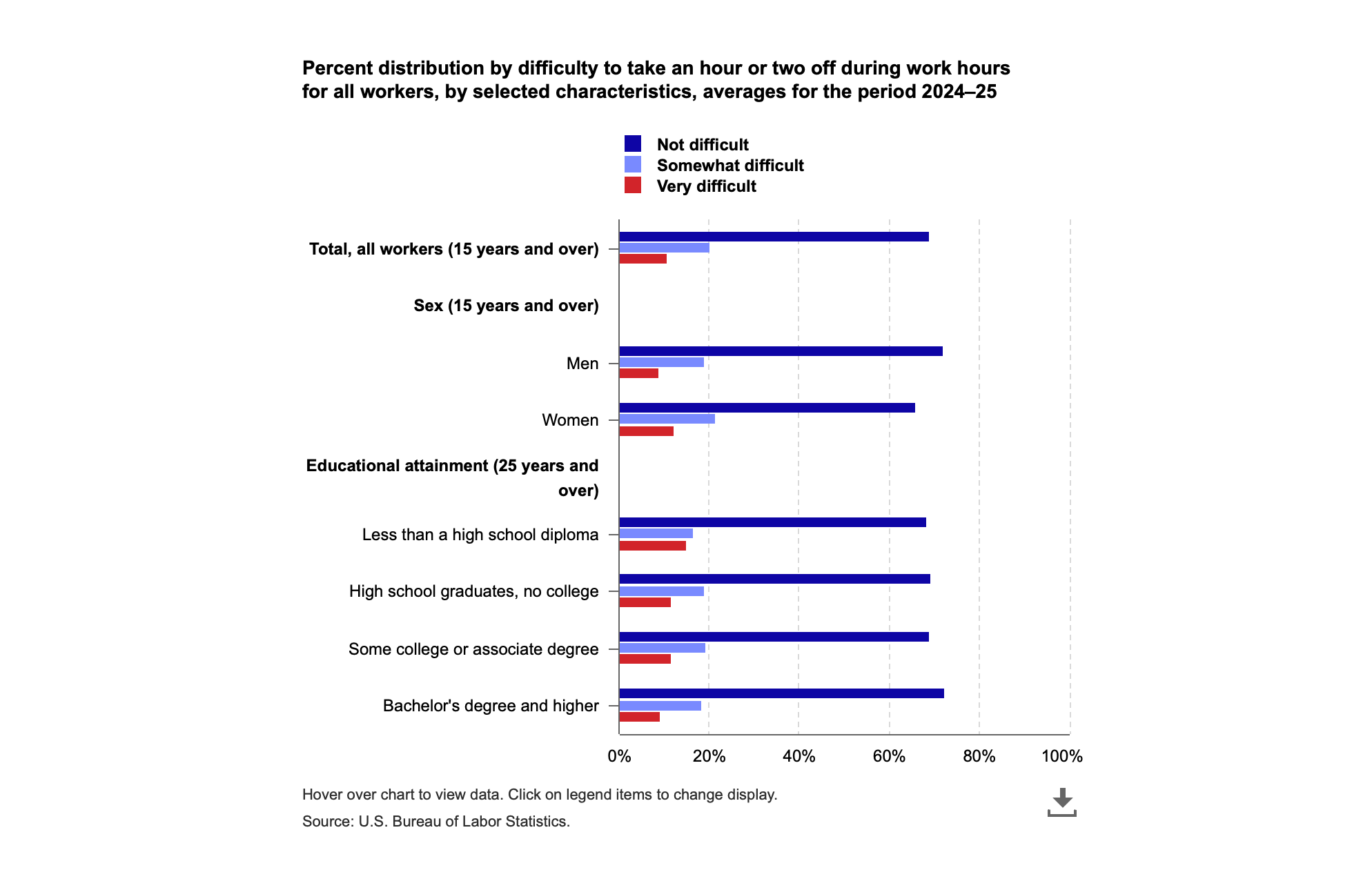
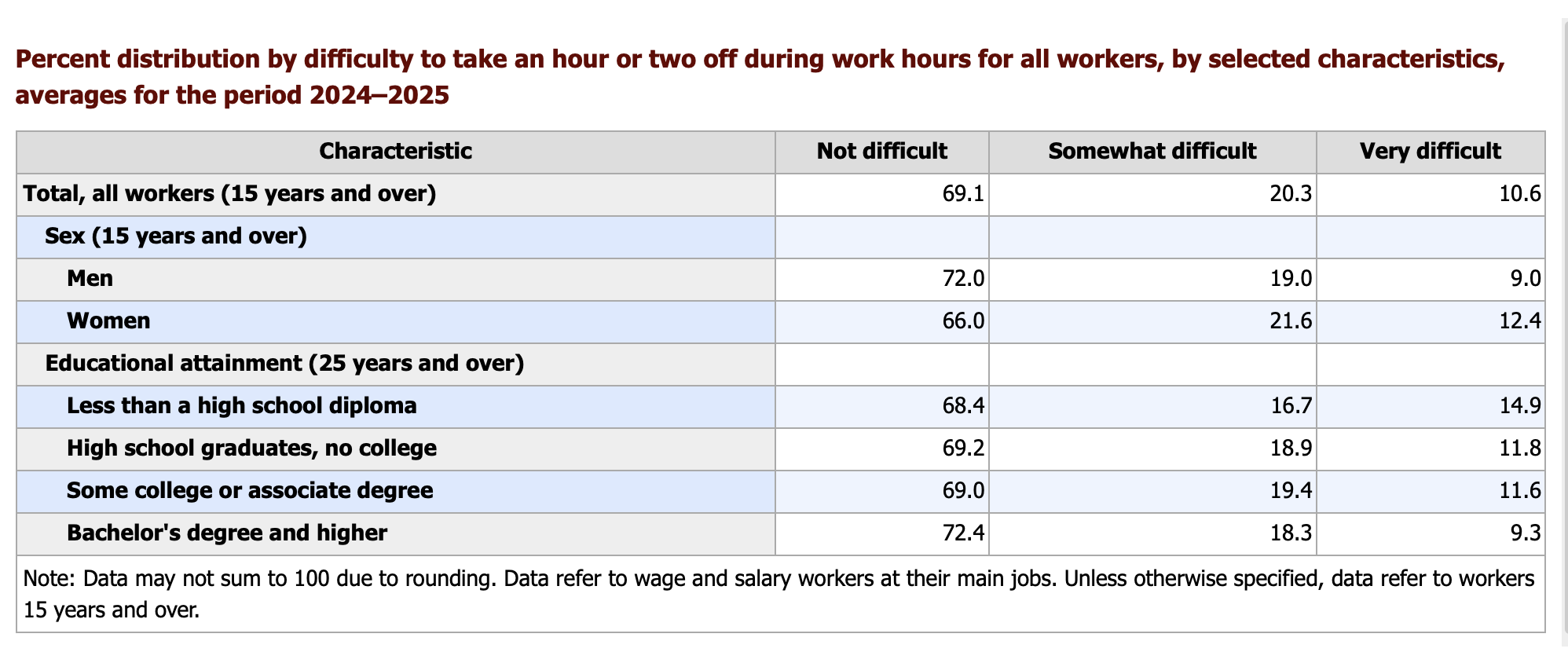
For some workers, as educational attainment increased, the ease of taking an hour or two off during work hours also increased. On average, workers who had a bachelor’s degree and higher (72.4 percent) were more likely to find it not difficult to take an hour or two off during work than workers who were high school graduates with no college (69.2 percent) and workers who had some college or associate degree (69.0 percent).
These data are from the American Time Use Survey (ATUS). Data are averages of data collected throughout 2024 and 2025 from a supplement to the ATUS, the 2024–25 Leave and Job Flexibilities Module. Estimates in this news release apply only to a person's sole or main job and exclude self-employed workers. For individuals with more than one job, the main job is the job in which they usually work the most hours.
Source: U.S. Bureau of Labor Statistics, The Economics Daily, November 9, 2026.