"Can I Play With You?" Might Be the Most Important Sentence a Preschooler Learns
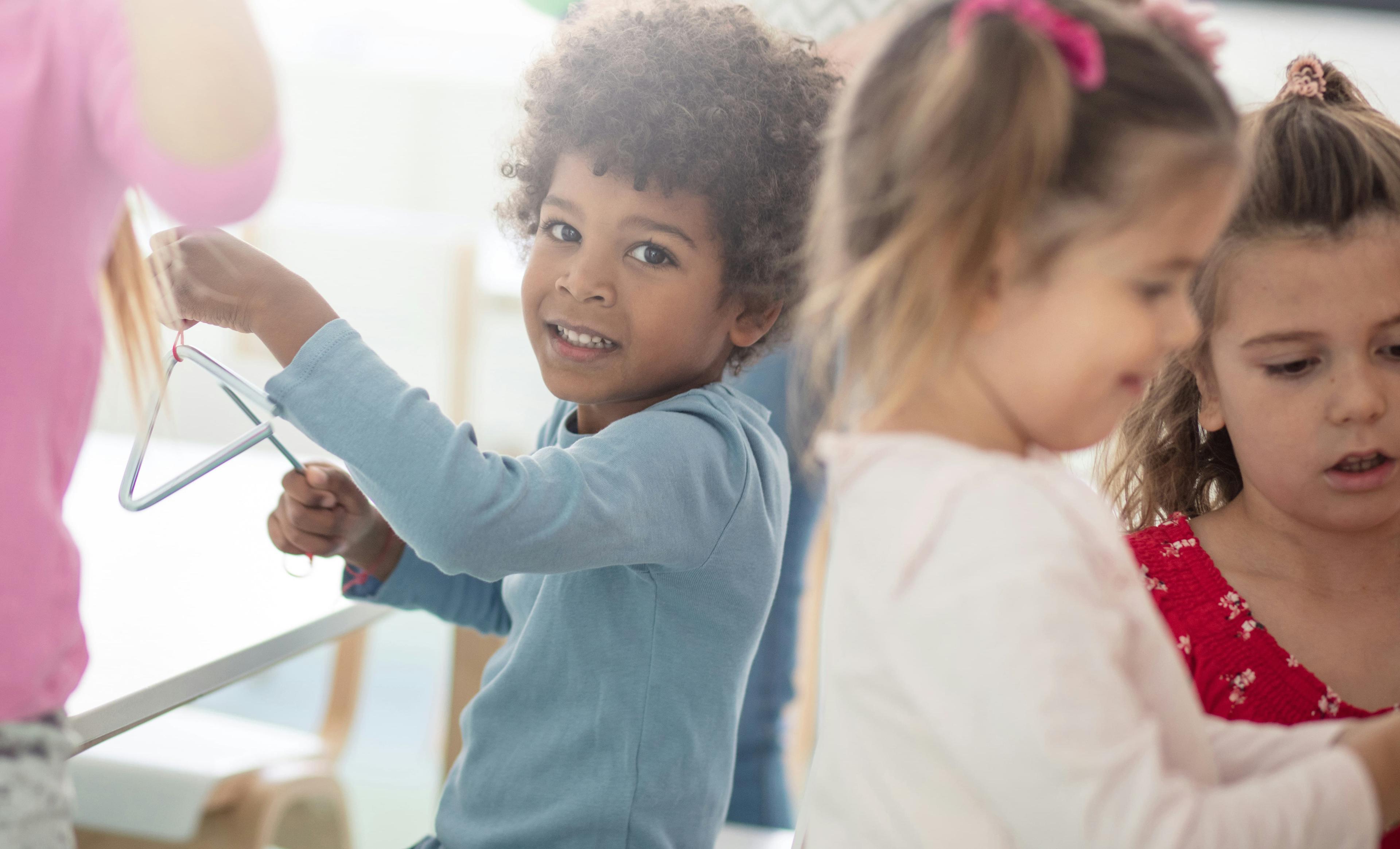
A child can count to 100, explain how a caterpillar becomes a butterfly, and give you an entire paragraph on why the seasons change. Five minutes later, that same child might be standing next to two classmates, desperately wanting to play and completely unsure how to ask.
After nearly two decades in early childhood education, I want every future teacher to recognize the learning in both moments.
I understand why new teachers look to academics first. If a child could count to 20 in September and can count to 100 by spring, you have something concrete to share at a conference. It’s easier to miss the moment a child works out a disagreement or notices a friend standing at the edge of a game. You might be on the other side of the room putting the same shoe back on for the third time that morning.
That’s why I’d give future teachers a research paper that sounds like it belongs in an economics class. In 2011, Harvard economist Raj Chetty and his colleagues published a study that linked records from a Tennessee experiment involving 11,571 students to their earnings as adults. Children assigned to kindergarten teachers with more than 10 years of experience earned, on average, $1,093 more per year between ages 25 and 27 than children assigned to teachers with 10 years of experience or fewer. The researchers noted that other qualities the more experienced teachers brought to their classrooms could help explain the difference (Chetty et al., 2011).
Here’s the part I’d want future teachers to sit with. In a separate analysis, early test-score gains associated with higher-quality kindergarten classrooms faded over time. Yet among students whose teachers rated their classroom behavior, those who had been in higher-quality kindergarten classrooms scored higher on a combined measure in fourth and eighth grade. The measure included effort, initiative, and participation. The researchers saw those behaviors as one possible explanation for why early classroom experiences continued to matter years later (Chetty et al., 2011).
The study leaves open which teaching practices helped children develop those skills. It gives me a question I’d bring to every student teaching placement. If initiative is one of the skills teachers can still see years after kindergarten, where do children get to practice it in your classroom today?
Picture two children reaching for the same toy. I can decide whose turn it is and settle the whole thing in ten seconds. With lunch coming and half the class still in their coats, believe me, I understand the appeal. But if I stay close and give them a few seconds, I might hear one child say, “You can have it when I’m done.” If they’re stuck, I can give them the words to ask for a turn and give the other child time to answer. If someone is getting hurt, I step in. Experience has taught me to watch closely enough to know what to do with those next ten seconds.
I saw how much children could work out when I stopped bringing toys outside. I wanted to see whether they’d start more play with one another, and over time I saw more cooperative play. Indoors, I saw it in our classroom kitchen when the children played birthday party. Once they decided there was going to be a party, they had to figure out who was doing what. I could have assigned everyone a job and gotten that party underway in record time. But then I’d have missed the chance to see who offered an idea, who listened, and how they figured out where another friend could fit. Anyone who has ever planned a real birthday party knows how much negotiating goes into one.
When I mentor a student teacher, I’d ask them to pick one interaction during free play and write down what the children actually say and do. Who starts the conversation? What happens when someone has a different idea? When does an adult’s help move things forward? Afterward, I’d ask one more question. What did you learn about that child because you waited?
You might discover that the child who rarely speaks during circle time can negotiate a turn during play. Or you might notice that a child keeps circling the same game because they’re trying to figure out how to join. That gives you something to teach tomorrow. Practice “Can I play with you?” together before recess. Then stay close enough to hear what happens and give the child a chance to ask.
And then there’s a milestone I wish we talked about as often as counting to 100. A child falls. A classmate stops playing, reaches out a hand, helps their friend up, and asks, “Are you okay?”
In those few seconds, that child noticed what happened, understood that someone might need help, and decided to offer it. That’s empathy and initiative in the middle of an ordinary school day. It’s part of what I mean by teaching the whole child. Knowing how to join a group, work through a disagreement, and show up for someone else will matter long after preschool.
At a parent-teacher conference, I’ll happily tell a family their child can count to 100. I want the teachers I mentor to come to that same conference ready to say, “I have one more thing to tell you. Today a friend fell, and your child stopped playing, reached out a hand, and asked, ‘Are you okay?’”
References
Chetty, R., Friedman, J. N., Hilger, N., Saez, E., Schanzenbach, D. W., & Yagan, D. (2011). How does your kindergarten classroom affect your earnings? Evidence from Project STAR. The Quarterly Journal of Economics, 126(4), 1593–1660. https://doi.org/10.1093/qje/qjr041



Join the discussion
Members can read and add comments on every article.